Why we need pollinators for food.
Why do we need a pollinator to plate connection? Do you like to eat? I’m guessing your answer is yes. We all need food; it’s the fuel for life. Can’t live without it. But here’s an amazing little fact that may surprise you and puts our lives into perspective: Pollinators are responsible for one out of every three bites of food we eat.
Stop and think about that staggering statistic for a minute. I first learned that fact several years ago in a college class, and it has stuck with me.
Every time you reach for an apple, ladle tomato sauce on pasta, or relish a piece of chocolate, you are participating in a relationship brought about by an insect, a bird, or a bat. Without these needed creatures, our diet would collapse into a bland, nutrient-poor boredom of wind-pollinated grains.
Over 75% of the world’s flowering plants rely on animal pollination to reproduce. Translating that to our dinner table, nearly 35% of food crops grown globally need pollinators. This isn't about luxury food items; it’s about the basic elements of global nutrition. Everything from apples, berries, tomatoes, and pumpkins to essential cash crops like almonds, cacao (chocolate), coffee, and vanilla is dependent on this winged workforce. Imagine a world without apple pie, strawberry shortcake, tomato sauce, or the simple joy of chocolate—that is the world we face if the pollinator crisis continues.
More Than Honey - The 4 B's
While the first things many people think of when talking about pollinators may be honey and honey bees, there is a bigger service that goes way beyond the hive. Around $217 billion of the global economy can be credited to pollination. In the United States, honey bees and native pollinators account for an average of $18 to $27 billion annually, with honey bees providing $3.3 billion of that amount.
- Bees (The Powerhouses): This includes over 20,000 known species around the world, such as bumble bees, which are essential for tomatoes and blueberries via "buzz pollination," and solitary bees (like mason bees and leaf-cutter bees), which are often more efficient pollinators than honey bees for specific fruits.
- Butterflies (The Long-Distance Travelers): While less efficient than bees, butterflies have an important role, particularly for flowering plants with specific structures. They are key pollinators for certain native wildflowers and garden favorites.
- Birds (The Specialized Feeders): Species like hummingbirds are primary pollinators for deep-throated, brightly colored flowers, such as those that produce bananas and some berries.
- Bats (The Night Shift): In tropical and desert ecosystems, nectar-feeding bats are indispensable for night-blooming plants, including those that give us fruits like agave, mango, and guavas.
Beyond these four groups, many other insects are critical. Tiny midges are the only insects capable of pollinating the complex cacao flower, making them the unseen architects of every chocolate bar.
The impact of pollinators isn't limited to direct fruit and vegetable production. Around 1200 crops rely on pollinators, including some that are essential for foundational elements of the agricultural industry:
- Forage for Livestock: Crops like alfalfa and clover, which are fundamental forage for cattle that provide us with milk, cheese, and steak, require pollination. When you enjoy a glass of milk or a juicy steak, remember the pollinator that made the feed possible.
- Yield Enhancement: Even in crops that can self-pollinate or are primarily wind-pollinated, the presence of bees can dramatically increase efficiency. For example, while soybeans don't strictly rely on pollinators, honey bees can boost the overall yield by as much as 40%. This increase in yield translates directly into greater food security and economic stability.
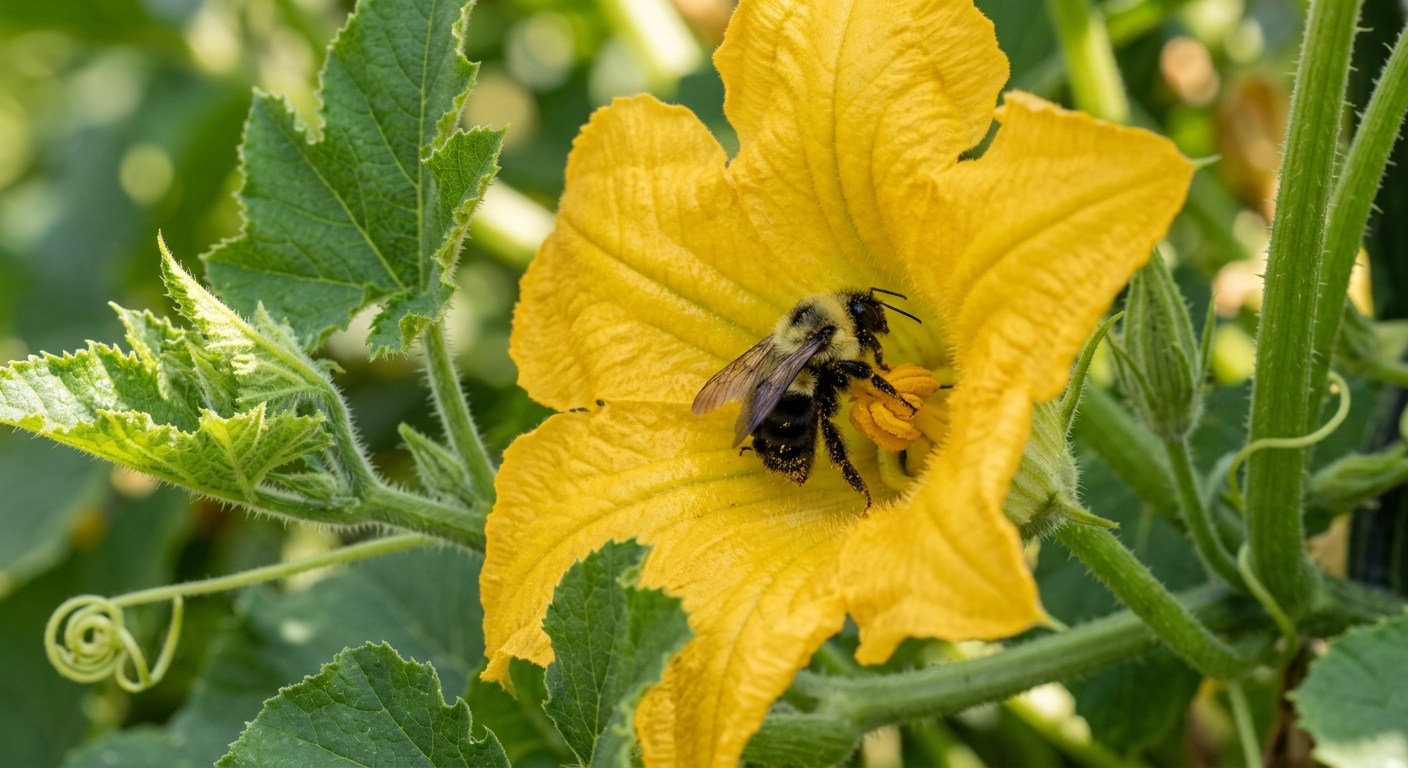
Bumble bee on squash bloom.
The Pollinator to Plate Crisis
Despite their immense value, pollinator populations around the world are facing a severe and escalating crisis. Their numbers continue to decline at alarming rates, threatening our food supply and the delicate balance of natural ecosystems.
In the US, there are 75 pollinator species listed as threatened or endangered. Across the globe, there are around 40% of invertebrates (like bees and butterflies) and 16.5% of vertebrates (like bats and birds) that are at risk.
The decline is not due to a single cause but rather a combination of interconnected stressors:
- Habitat Loss and Fragmentation: As natural areas are converted to monoculture farms, housing, and infrastructure, pollinators lose the diverse forage and nesting sites they need to survive. A continuous supply of different flowering plants is necessary to sustain them from spring to fall.
- Pesticide Use: Systemic insecticides, particularly neonicotinoids, are highly toxic to bees. These chemicals are absorbed by the plant and are present in the pollen and nectar, poisoning the food source. Even non-lethal doses can impair navigation, memory, and foraging behavior, leading to colony collapse.
- Disease and Parasites: The spread of pathogens and parasites, such as the Varroa mite in honey bee colonies, is a major contributing factor. These diseases are often worse when bees are stressed by poor nutrition or pesticide exposure.
- Climate Change: Changes in weather patterns disrupt the delicate timing between when flowers bloom and when pollinators emerge. Early springs or late frosts can lead to a "pollinator-plant mismatch," starving the insects and preventing flower reproduction.
Take Action
The scale of the crisis can feel overwhelming, but the good news is that solutions are readily available that can make a difference.
Plant for Pollinators: Create a "Pollinator Pathway" by planting native, diverse, and continuous-blooming flowers. Avoid hybrid plants that may produce little to no pollen or nectar.
- Reduce Pesticide Use: Avoid using systemic and broad-spectrum insecticides in gardens and farms. If pesticides are necessary, use targeted applications and apply them only when bees are not actively foraging (i.e., at dusk).
- Provide Shelter: Bees need nesting sites. This can mean leaving patches of undisturbed soil for ground-nesting solitary bees or building "bee hotels" for cavity-nesting species. For butterflies and birds, preserve native shrubs and trees.
Support Sustainable Agriculture: Choose food products that are labeled "organic" or "sustainably grown," which often signifies a commitment to reducing harmful pesticide use and preserving pollinator habitats.
The fate of our food and the health of our planet are tied to the survival of this small, winged army. By recognizing their value and taking deliberate action, we can safeguard the future of our dinner table, ensuring that the amazing fact of one out of every three bites continues to be a truth we can rely on.